← C++ 高级程序设计(2020) 2020-C++高级程序设计-C++ 输入输出 2020-07-01 约 32 分钟阅读 阅读 — 次
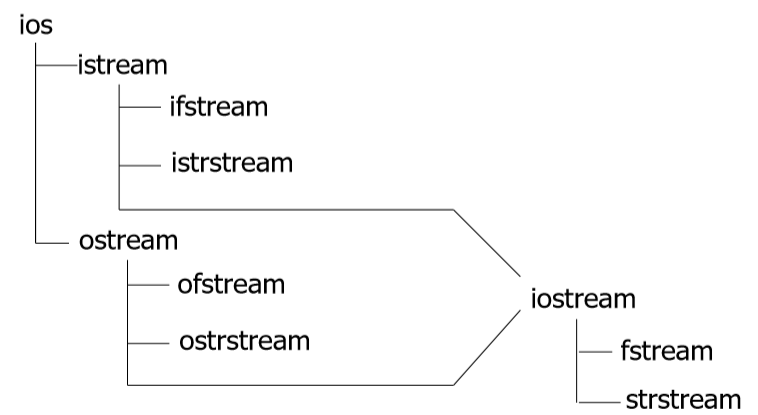
输入输出流:包含在头文件<iostream>中
开头需要进行#include<iostream>
对象
功能
istream:cin
处理输入
ostream:cout
处理输出
ostream:cerr
处理错误
ostream:clog
保证log
程序的输入都键入一个缓冲区,即输入缓冲区。
键盘输入结束后,会将数据存入缓冲区,之后cin函数直接从输入缓冲区取数据
问题在于:缓冲区中有残留数据的时候,cin输入流直接从缓冲区拿数据。
>>是流提取符,以空格,\t(Tab),\n(回车)为终止往往使用来赋值给变量
cin的变量类型可以为int、float、char、char*、string等诸多类型。
1 2 3 4 5 6 7 8 9 for (int i = 0 ;i < n; i++){while (cin >> n){
1 2 3 4 5 char c;int x1,x2,y1,y2
1
2
3
4
5
6
int get () istream& get (char & c) ;istream& get (char * s, streamsize n) ;istream& get (char * s, streamsize n, char delim) ;istream& get (streambuf& sb) ;istream& get (streambuf& sb, char delim) ;
结束符默认为enter,结束字符串的读写
字符串最后一个为\0,并且对空格不敏感。
get方法并不会将结束符从缓冲区丢弃 :务必注意是结束符!未必是回车。
1 2 3 4 5 6 7 8 9 10 11 12 get (x);get (y);char ch1,ch2[10 ];"请输入字符串:" <<endl;get (ch2,6 );get (ch1);"\n" <<(int )ch1<<endl;
直接回车在上面程序中会出现错误输出(越界),处理方法cin.clear():但是不会清理终止符。
1 2 3 4 5 6 7 8 9 10 11 get (ch, 3 , 'a' );get (ch2);get (ch, 3 , 'a' ); get (); ' ' << (int )ch2 << endl;get ();
cin.getline(字符数组名,接收长度,结束符)cin.get()超长后不会影响cin的操作,而cin.getline()如果超长会导致之后cin的错误。
getline(istream is,string str,结束符)
定义在IOS类中
他们不是储存异常状态常量,而是对应状态为的掩码。
名称
二进制显示
功能
failbit
001
输入(输出)流出现致命错误,不可挽回
eofbit
010
已经到达文件尾
badbit
100
输入(输出)流出现非致命错误,可挽回
goodbit
000
流状态完全正常,各异常标志位都为0
1
2
3
4
cout << ios::failbit << endl;
rdstate():获取标志变量的值
1
2
3
4
5
6
7
void TestFlags ( ios& x ) rdstate ( ) & ios::badbit ) << endl; rdstate ( ) & ios::failbit ) << endl; rdstate ( ) & ios::eofbit ) << endl;
1 or true if rdstate & failbit is nonzero, otherwise 0 or false. (引用msdn)
其中rdstate即通过rdstate()取得的标识变量的值,与failbit相与,即取得failbit标志位的值,如果结果非零则放回true,否则返回false。即该函数返回failbit的状态,将标志位状态通过bool值返回。
1 or true if rdstate & badbit is nonzero; otherwise 0. (引用msdn)
1 or true if rdstate == goodbit (no state flags are set), otherwise, 0 orfalse. (引用msdn)
该函数用来重置标识变量,_State是用来重置的值,默认为goodbit,即默认时将所有标志位清零。用户也可以传进参数,如:clear(failbit),这样就将标识变量置为failbit(即:001)。
我们一般是用它的默认值,当cin出现异常,我们用该函数将所有标志位重置。如果cin出现异常,没有重置标志的话没法执行下一次的cin操作。如上一节的程序2的测试二为什么第二次输入操作没有执行?程序8中 cin>>ch 为什么没有执行?都是这个原因!!!
这个函数也是用来设置标识变量的,但与clear()不同。clear()是将所有标志清零,在置以参数新的标志。而该函数不清零其他的标志,而只是将参数对应的标志位置位。这个函数不是经常使用,这里不再赘述。
1 2 3 4 5 6 7 8 9 10 11 12 13 14 15 16 17 18 19 20 #include <iostream> using namespace std; int main () char ch, str[20 ]; getline (str, 5 ); "flag1:" <<cin.good ()<<endl; clear (); "flag1:" <<cin.good ()<<endl; "str:" <<str<<endl; "ch :" <<ch<<endl; return 0 ;
【分析】程序执行结束还是只执行了一次读操作,cin>>ch还是没有从键盘读取数据,但是与程序8中不同,这里打印了ch的值为’5’,而且在cin>>ch之前已经清楚了错误标志,也就是cin>>ch的读操作实际上执行了。这就是前面讲的cin读取数据的原理:它是直接从输入缓冲区中取数据的。此例中,第一次输入"12345",而getline(str, 5)根据参数’5’只取缓冲区中的前4个字符,所以str取的是"1234",而字符’5’仍在缓冲区中,所以cin>>ch直接从缓冲区中取得数据,没有从键盘读取数据!
也就是当前一次读取数据出错后,如果缓冲区没有清空的话,重置错误标志还不够!要是能将缓冲区的残留数据清空了就好了哦!下面我们再来看一个很重要的函数!
Causes a number of elements to be skipped from the current readposition
Parameters:
_Count, The number of elements to skip from the current read position.
_Delim, The element that, if encountered before count, causes ignore to returnand allowing all elements after _Delim to be read. (引用msdn)\
这个函数用来丢弃输入缓冲区中的字符,第一参数定义一个数,第二个参数定义一个字符变量。下面解释一下函数是怎样执行的:函数不停的从缓冲区中取一个字符,并判断是不是_Delim,如果不是则丢弃并进行计数,当计数达到_Count退出,如果是则丢弃字符退出。例:cin.ignore(5, ‘a’); 函数将不断从缓冲区中取一个字符丢弃,直到丢弃的字符数达到5或者读取的字符为’a’。下面我们看个程序例子:
1 2 3 4 5 6 7 8 9 #include <iostream> using namespace std;int main () char ch;ignore (5 , 'a' );get (ch);int )ch << endl;return 0 ;
例子见参考三
cin.ignore():删除缓冲区的第一个字符
cin.ignore(1024,'\n');cin.ignore(std::numeric_limits<std::streamsize>::max(), '\n');
getchar();获得一个字符
可以读取到空格\n等等的字符。
putchar();输出一个字符
<<流插入符
std::endl:换行,可以输出一个或者多个,等价于\n
1 2 3 4 5 6 7 8 9 10 #include <iomanip> 10 << "" << oct << 8 ;setorecison (4 ) << 1.11111 ;setw (6 ) << right << 10 ;'-' << setw (2 ) << setfill ('0' ) << month << ‘-’ << std::setw (2 ) << std::setfill ('0' ) << day;
using namespace std;来直接使用
cin,cout是C++标准库内置函数但不是关键字。
scanf(“%d”,&a);
printf(“%d”,a);
基于函数库的I/O
基于类库的I/O
控制台I/O:标准I/O设备(cin、cout、cerr、clog)
文件I/O
字符串I/O
1
2
3
4
5
6
7
8
9
10
11
12
13
ifstream in ("in. txt" ) ;rdbuf ();rdbuf ( in. rdbuf ());ofstream out (" out. txt " ) ;rdbuf (); rdbuf ( out. rdbuf ()); " " ;rdbuf ( cinbuf );rdbuf ( coutbuf );
对自定义类的对象的I/O
全局(友元)函数重载
1
2
3
4
5
6
7
8
9
10
11
12
13
14
15
16
17
18
19
20
21
22
23
24
25
26
27
class CPoint2D {double x, y;public :friend ostream& operator << (ostream&, CPoint2D &);operator << (ostream& out, CPoint2D& a){"," << a.y << endl;return out;class CPoint3D : public CPoint2Ddouble z;class CPoint3D : public CPoint2Ddouble z;friend ostream& operator << (ostream &, CPoint3D &);operator << (ostream& out, CPoint3D & b){"," << b.y <<"," << b.z << endl;return out;
1 2 3 4 5 6 7 8 9 10 11 12 13 14 15 16 17 18 19 20 21 class CPoint2D {double x, y;public :virtual void display (ostream& out) "," << y << endl;operator << (ostream& out, CPoint2D &a){display (out);return out;class CPoint3D : public CPoint2D{double z;public :void display (ostream& out) display ();"," << z << endl; }
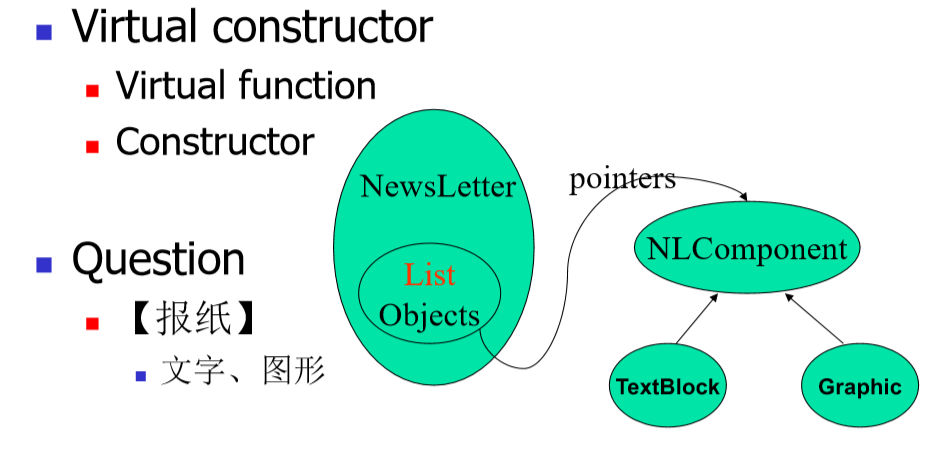
虚函数
构造器
1
2
3
4
5
6
7
8
9
10
11
12
13
14
15
16
17
18
19
20
21
22
23
24
25
26
27
28
29
30
31
32
33
34
35
36
37
38
39
40
41
42
43
44
class NLComponent {…};class TextBlock :public NLComponent {…};class Graphic :public NLComponent {…};class NewsLetter {public :NewsLetter (istream& str){while (str)push_back (readComponent (str));static NLComponent * readComponent (istream& str) NewsLetter (const NewsLetter& rhs){for (list<NLComponent *>::iterator it=rhs.component.begin ();it != rhs.component.end (); ++it )push_back ();private :virtual NLComponent *clone () const 0 ;virtual TextBlock *clone () const return new TextBlock (*this );virtual Graphic *clone () const return new Graphic (*this );NewsLetter ( const NewsLetter& rhs){for ( list<NLComponent *>::iterator it=rhs.component.begin ();end (); ++it )push_back ((*it)->clone ());class BST {};class BalancedBST : public BST {};void printBSTArray (ostream& s, const BST array[], int numElements) for (int i=0 ; i < numElements; i++)10 ];printBSTArray (cout, bBSTArray, 10 );
1
2
3
4
5
6
7
8
9
10
11
ifstream infile ("file_name" ) ;if (!infile.is_open ()){"未成功打开文件" << endl;int arr[26 ] = { 0 };char c;while (!infile.eof ()) {
如果(a - int(a)) > 1E-7:则认为是double
否则为int
cin、cin.get()、cin.getline()、getline()的区别 
评论